




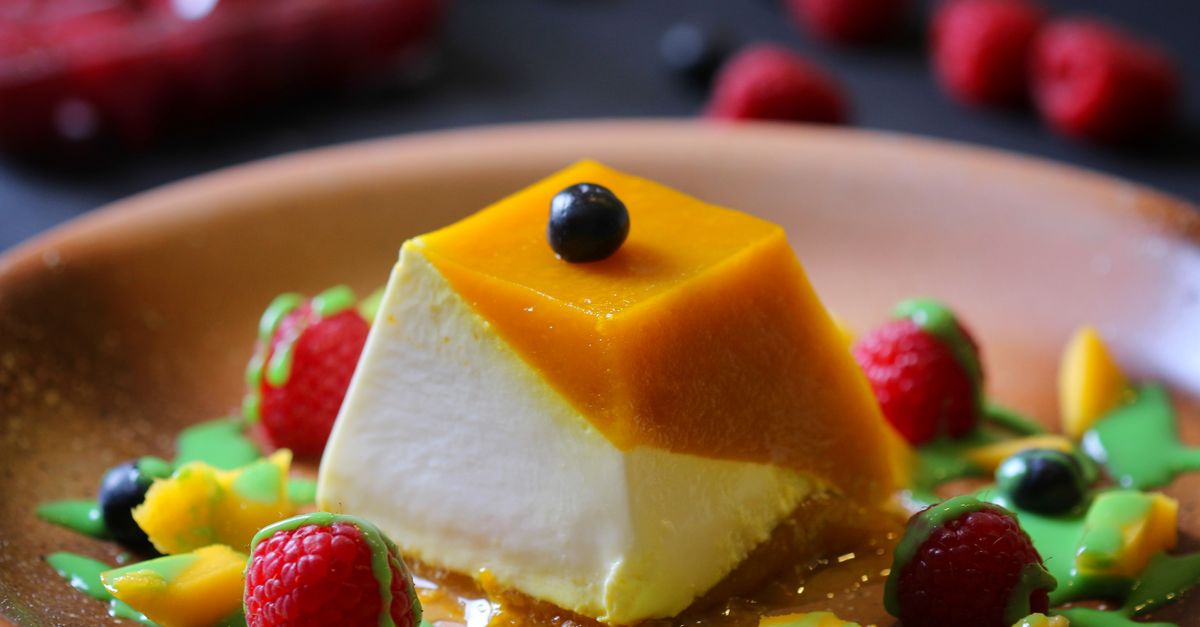
Cold dairy desserts offer some of the strongest operational characteristics of any dessert category. They can be made in advance, held properly for several days, and plated in under a minute during service. The technique barriers are modest. The ingredient costs are favorable. The guest experience is high. The challenge is not the recipe. It is building the production systems that allow consistent, scalable execution across multiple service periods without dedicated pastry staff at every station.
Panna Cotta: The Most Scalable Dessert in Your Kitchen
Panna cotta is three core ingredients: cream, sugar, and gelatin. It scales linearly from four portions to forty without any technique adjustment. It can be made three days in advance without quality loss. It plates in under a minute. And it accommodates virtually any flavor or seasonal garnish without changing the base recipe.
The ratio that works reliably: two cups heavy cream, three tablespoons sugar, and one and a half teaspoons powdered gelatin per four portions. Bloom gelatin in two tablespoons of cold cream for five minutes before heating. Warm the remaining cream with sugar until sugar dissolves but cream does not boil. Combine with bloomed gelatin, whisk until fully dissolved, strain, and pour into ramekins. Set in refrigeration for a minimum of four hours.
At restaurant scale, make panna cotta in batches of forty to sixty portions every two to three days. Covered in the ramekins with plastic wrap, properly refrigerated panna cotta holds well for four to five days without quality loss. Three production sessions per week comfortably covers seven days of service with fresh product throughout.
Flavor variations come easily without altering the base. Steep cream with vanilla, coffee beans, citrus zest, or fresh herbs before straining and adding gelatin. Buttermilk panna cotta replaces half the cream with buttermilk added off heat, creating a tangy profile that works in contexts where vanilla feels predictable. The base handles any of these additions without requiring a different recipe or technique.
Garnish and Seasonal Rotation
The most efficient way to keep a panna cotta program interesting is to keep the base constant and rotate the garnish seasonally. Your team makes the same thing every time. The guest experience changes with each season.
Summer: macerated fresh berries with a touch of sugar and lemon zest. Fall: warm spiced apple butter with candied walnuts. Winter: blood orange segments with bitter chocolate and flaky salt. Spring: lemon curd with fresh strawberries and torn mint. Each of these garnishes requires minimal prep, uses ingredients already in your kitchen, and creates a distinct presentation that photographs well.
Portion sauces and garnishes in advance during prep so service plating is genuinely a one-minute operation. Pre-sauced plates, pre-portioned garnishes, and panna cottas ready to unmold make the dessert course as operationally simple as it appears to guests.
In-House Ice Cream Without a Full Pastry Program
In-house ice cream does not require a pastry chef or elaborate equipment. It requires a reliable base recipe, a commercial ice cream machine sized appropriately for your volume, and a production schedule that keeps fresh product available throughout the week.
A Philadelphia-style base without eggs is the simplest to scale. Two cups heavy cream, one cup whole milk, three-quarters cup sugar, and a pinch of salt. Dissolve sugar in milk over low heat, combine with cream, chill thoroughly for at least four hours, and spin according to your machine’s instructions. This produces a clean, neutral base that carries any flavoring without interference.
Make base in large batches and spin multiple flavors from the same batch by splitting before spinning and adding flavorings. Pack spun ice cream in hotel pans and blast-chill immediately. Properly made ice cream stored below zero degrees Fahrenheit holds quality for two weeks, giving you significant flexibility in production scheduling.
Two rotating house flavors keep the program manageable. A consistent vanilla and a rotating seasonal option give regular guests something new while keeping production focused. Fighting the instinct to offer eight flavors before you have mastered two is one of the most valuable production discipline decisions you can make.
Semifreddo: Restaurant-Scale Ice Cream Without the Machine
Semifreddo is a frozen mousse that achieves ice cream-adjacent texture through whipped cream and eggs rather than the churning process. It requires no ice cream machine, freezes in a standard freezer, and produces a product that slices cleanly and holds its shape slightly longer than ice cream at room temperature.
The base ratio: four egg yolks, half cup sugar, and two cups heavy cream. Whip yolks and sugar together until pale, thick, and ribbony. Separately whip cream to soft peaks. Fold the two together gently to preserve volume. Add flavoring, pour into a parchment-lined loaf pan, cover, and freeze for a minimum of six hours.
The resulting texture is slightly denser than premium ice cream but lighter than most frozen desserts. It slices with a knife warmed briefly under hot water, portions consistently, and presents elegantly with sauce poured alongside or garnish placed on top. The rate at which it softens is more forgiving than ice cream, giving you a wider plating window during service.
For operations that want an ice cream-adjacent dessert without the machine investment or the production demands of churned ice cream, semifreddo is the most practical answer. The only equipment required is a mixer and a freezer.
Service Execution for Cold Desserts
Cold dairy desserts fail in service when plating takes too long. Every second a panna cotta rests on a warm plate or an ice cream scoop sits under a heat lamp, quality degrades visibly. The solution is pre-staging, not speed.
Pre-chill dessert plates before service. Scoop ice cream into pre-portioned balls and return them to the freezer rather than scooping to order. Position everything needed for dessert plating at the dessert station before the first ticket arrives. Sauce everything before removing the dessert from refrigeration, not after. These preparation habits transform dessert plating from a rushed afterthought into a ten-second execution.
Assign dessert plating responsibility clearly during pre-shift. In kitchens without a designated pastry station, cold dessert plating gets neglected during service or handed to whoever is available at the worst possible moment. Clarity on who handles desserts and where everything is staged prevents the fumbling that undermines otherwise excellent dessert execution.
What This Means for Your Dessert Program
Cold dairy desserts are the most operationally efficient desserts you can offer. High contribution margin, advance production, fast plating, and manageable skill requirements at the point of service make them ideal for kitchens where dedicated pastry staff are not realistic.
Building your dessert program around one or two well-executed cold dairy options and supplementing with a sourced item where necessary keeps the kitchen productive without adding significant labor. The investment is in initial recipe development and production system setup, not in ongoing daily complexity. Once the system exists, maintaining it is straightforward.